
Introduction
Among the gas products used in the energy and chemical sectors, isobutane holds a special place. This gas, which is used in many areas from industrial processes to our daily lives, offers significant advantages both commercially and environmentally. In this article, we will examine isobutane usage in detail; we will review its contributions to the energy, cooling, chemical, and logistics sectors. We will also touch on the future market potential and business opportunities of isobutane.
What is Isobutane?
Isobutane (C4H10) is an isomer of butane gas and is a colorless, flammable hydrocarbon. It is obtained during the processing of natural gas and petroleum. When produced in high purity, it stands out as a reliable and economical solution in various industries.
Main features:
- Cooling property due to its low boiling point
- High flammability for energy efficiency
- Can be used as an intermediate substance in chemical production
- Provides safety and ease in transportation
Chemical Properties of Isobutane
Chemically, isobutane is a simple hydrocarbon belonging to the alkane group. Its molecular structure makes it easy to compress and liquefy. This feature makes its storage and transportation quite practical.
In addition:
- Low toxicity: Harmless to human health when used within certain safety limits
- Environmentally friendly: Does not damage the ozone layer and is more eco-friendly compared to alternative refrigerant gases
- High energy density: Can store large amounts of energy even in small volumes
Isobutane Usage in the Energy Sector
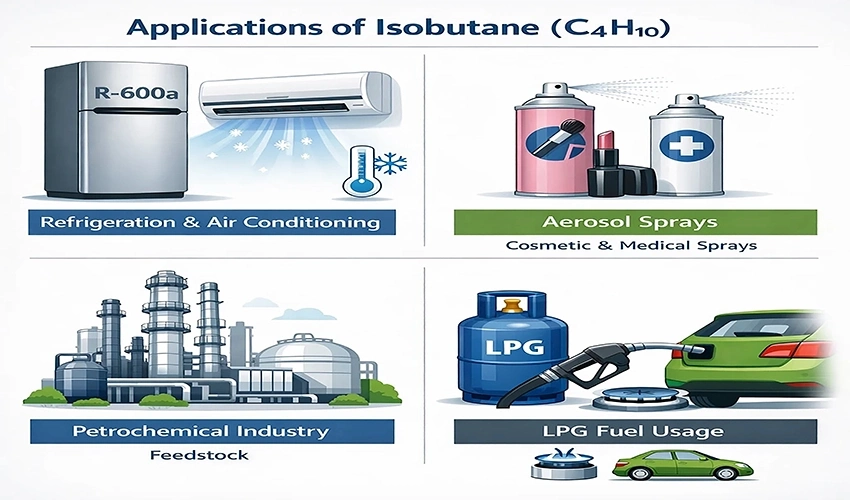
The energy sector is one of the largest markets for isobutane usage. Isobutane is widely used especially in LPG (Liquefied Petroleum Gas) mixtures.
Applications:
- In household LPG cylinders for heating and cooking
- As an energy source in industrial facilities
- As an alternative fuel in transportation
Isobutane in Cooling Systems
In cooling technologies, isobutane has emerged in recent years as an eco-friendly alternative. Due to the environmental harm caused by traditional refrigerant gases (CFCs and HFCs), manufacturers have turned to safer options.
Isobutane usage is seen in the following areas:
- Household refrigerators
- Air conditioning systems
- Industrial cooling units
- Food storage and logistics centers
Isobutane in the Chemical Industry
The chemical industry is one of the most critical areas of isobutane usage. Isobutane is used as an intermediate substance in the production of many chemical products.
Main applications:
- Used as a raw material in the production of isobutylene
- In the production of plastics, rubber, and polymers
- Preferred as a propellant in aerosol products
- Used in the preparation of synthetic oils and solvents
Isobutane and Environmental Factors
Today, environmental sustainability is important in the energy and chemical sectors, as in every field. Isobutane stands out as a less harmful option environmentally.
- Ozone friendly: Does not damage the ozone layer
- Low greenhouse effect: Low carbon dioxide emissions
- Recyclable: Can be reused in storage and transportation systems
Logistical and Commercial Advantages of Isobutane
Another factor that increases the commercial value of isobutane is logistical convenience. Its ability to be transported in liquefied form reduces storage and transportation costs. In addition, isobutane is a highly demanded item in international trade among energy products.
Commercial advantages:
- Low transportation cost
- Easy storage conditions
- Wide demand in global markets
- High profit margin opportunity
Future and Market Potential of Isobutane
In the global energy transition process, isobutane will become more important due to its eco-friendly and economical structure. International reports predict that demand for isobutane will increase by more than 20% over the next decade.
Conclusion and Business Advantages
In summary, isobutane usage covers a wide range in the energy, cooling, and chemical industries. Thanks to its environmentally friendly nature, economic advantages, and logistical ease, it is a strategic product for commercial companies.
Main advantages for companies using isobutane:
- High efficiency
- Low cost
- Eco-friendly solutions
- Global trade potential